The Central Economic Work Conference has made it clear that the policy of "trade-in programs for consumer goods" will continue in 2026. Under this favorable policy, the home appliance and home furnishings industry is undergoing a profound transformation: consumers are no longer satisfied with single functions but are increasingly seeking integrated solutions like "whole-home smart systems" and "scenario-based integration."
As 2026 approaches, how can the home appliance and home furnishings industry outline a new blueprint for high-quality growth? Recently, Red Star Macalline's 2025 Home Appliance Integration Development Think Tank was held in Shanghai. Industry participants discussed the trends of earlier-stage consumption, intelligent upgrades, and green transformation in the home appliance and home furnishings sector, exploring strategies for integrated development.

Currently, the home appliance industry is in a critical period of transitioning from scale expansion to quality and efficiency, marked by notable trends toward early-stage planning, smart integration, and green upgrades. The selection of appliances is no longer limited to functional additions at the later stages of renovation but is now integrated into early phases such as floor plan design and turnkey property fittings. A new trend is emerging where consumers select appliances first before finalizing interior designs. At the same time, consumer demand for appliances has shifted from merely fulfilling single functions to upgrading needs that combine quality experiences, emotional value, and attributes of green and smart technology.
According to data from the Ministry of Commerce, by November 2025, the trade-in policy had driven the replacement of over 128 million home appliances, with first-tier energy-efficient appliances accounting for more than 90% of the total. High-end, smart, and green appliances such as smart air conditioners, built-in refrigerators, and washer-dryer sets are increasingly making their way into ordinary households.
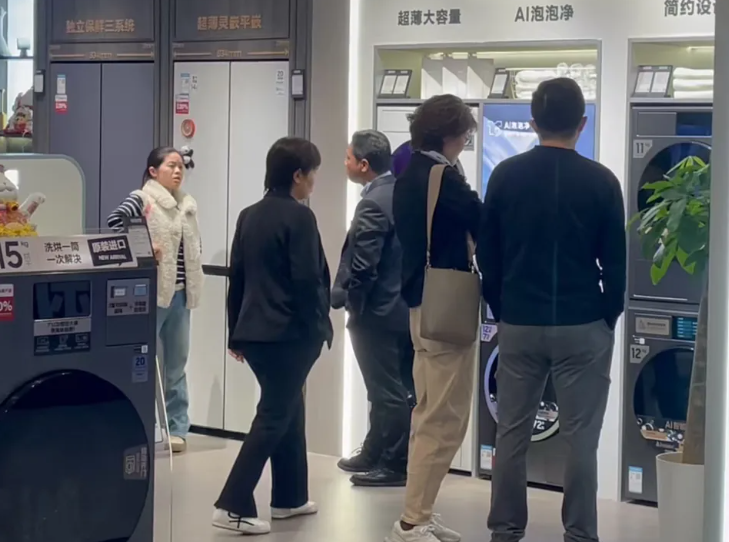
Ge Sen, Secretary-General of the Shanghai Communications, Electrical Appliances, and Home Electronics Business Association, provided an in-depth interpretation of policy trends and conducted a detailed market analysis during the sharing session. He pointed out that the recent Central Economic Work Conference has confirmed the continuation of the "consumer goods trade-in" policy in 2026. The optimization and precise implementation of follow-up policies will effectively drive the sustained release of consumption potential for green and smart home appliances.
Chen Hao, Head of the Planning Department at Red Star Macalline’s Shanghai Operations and Development Center, noted that as of November 30, 2025, the national and municipal subsidy programs had driven 476,000 orders in the appliance category on the Red Star Macalline platform, generating sales of 3.81 billion yuan. During the same period, Shanghai’s performance was particularly outstanding, with 257,000 orders and total sales of 2.31 billion yuan, making it a model region nationwide for policy-driven consumption. The remarkable results are attributed not only to the consumption dividends released through government-enterprise subsidy collaborations but also to Red Star Macalline’s strong capabilities in connecting supply and demand and stimulating the consumption potential of home appliances.
"Despite the current market pressures, Red Star Macalline leverages its platform advantages and ecosystem synergy to empower partners comprehensively and jointly explore new growth opportunities," revealed Zhao Lei, Senior Vice President of Red Star Macalline Home Furnishing Group. Currently, the appliance retail space in Red Star Macalline’s Shanghai area exceeds 100,000 square meters, accounting for 11.4% of the total retail space, with partnerships established across 150 appliance brands.
Han Jianhua, Party Branch Secretary of the Shanghai Communications, Electrical Appliances, and Home Electronics Business Association, offered suggestions from an industry development perspective. He noted that the market currently exhibits a new characteristic of strong supply but weaker demand. Home appliance manufacturers and distributors need to accurately grasp consumption trends, align supply with demand effectively, meet the market’s diverse needs, and promote industry quality improvement, efficiency enhancement, and high-quality development.
Representatives from factory heads and dealers of brands such as Haier/Casarte, Midea, Hisense, Fotile, Robam, BSH, Bosch, Siemens, Rinnai, and A.O. Smith shared their views. There was a consensus that competition in the home appliance and home furnishings industry has evolved from single-product rivalry to ecosystem synergy. By providing diverse service scenarios centered around "people," home appliances can be better integrated into home spaces, helping partnered brands transition from "selling products" to "offering one-stop lifestyle solutions."